Sunday, September 14, 2014

#BlogElul: The Jewish Cellist


As regular readers of this blog know, my sister runs her own company, The Art of Perception, providing training to law enforcement and medical personnel, as well as other professionals in various fields to enhance their observation, perception, and communications skills.  She uses various works of art as the "data set," encouraging participants to describe -- objectively, concisely, and clearly -- exactly what it is they see.  

The following anecdote from one of her training session illustrates just how important it is to listen carefully, how dangerous it can be to make assumptions and judgments, and how necessary it is to step back and ask if we are justified in relying on those assumptions -- or if they cause us to misjudge or prejudge. 
  
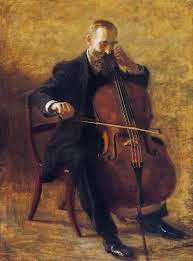
Upon showing Thomas Eakins' The Cello Player to a roomful of law enforcement agents, the following exchange ensued:
Amy:  "What do you see?"
Participant:  "The man in that picture is Jewish." 
Amy:  "Well, that is a conclusion. What observations did you make to get to that conclusion?" 
Participant:  "That's easy; all musicians are Jewish." 
Amy:  "Well, now you have drawn two conclusions--that the man is a musician and that all musicians are Jewish. Walk me through your thought process." 
The participant proceeded to narrate her thoughts: "During WWII, the Nazis put Jews in concentration camps. In some of the camps, they formed chamber music groups so that when the Red Cross came through, they could see that everything was ok." 
Amy cut her off and said that in the painting, there was a man sitting in a chair playing a cello. Where did she see the Nazis, chamber music groups, or the Red Cross? 
The participant looked at my sister, irritated, and snapped back, "Well, you asked me what I thought of when I looked at the painting." 
To which Amy replied, "With all due respect, I did not.  I asked, 'What do you see, not what do you think.'"
We all have Jewish cellists in our lives. 

How did they get there?

What can we do to get rid of them?


Inspired by Ima on (and off) the Bima, this #BlogElul post is one in a series marking the days of the Hebrew month of Elul, which precedes the Jewish High Holidays and traditionally serves as a time of reflection and spiritual preparation for the new year. 

Saturday, September 13, 2014

#BlogElul: Ask

Last year as part of #BlogElul, I wrote this post about whether or not I ask too much of myself.

More recently, various events in my life have been so stunning and, in some cases, so frustrating that the only question I find myself able to ask, isn't even one suitable for a "family blog."  More and more often, I find myself throwing my hands in the air in disbelief and uttering, "What the #!$%@^$#%?!?"

I'm not particularly proud that this is the question I've been asking (and I certainly don't expect an answer), but sometimes, it's just the most appropriate initial inquiry one can make.


Inspired by Ima on (and off) the Bima, this #BlogElul post is one in a series marking the days of the Hebrew month of Elul, which precedes the Jewish High Holidays and traditionally serves as a time of reflection and spiritual preparation for the new year. 

Friday, September 12, 2014

#BlogElul: Pray

You know that old Jewish joke about synagogue services?

You know?... The one where Schwartz says that Goldberg attends synagogue to talk to God, but that Schwartz goes only to talk to Goldberg.

In the world of worship, I'm definitely a Goldberg...and I love when we get to this part of the Shabbat service:
We sit in community:
elbow to elbow, eye to eye.
So close, perhaps, we brush against each other
as we move in prayer.
Ears filled with the voices of friends, teachers, fellow travelers —
who pray with us from the next seat, from across the room.
We come to silence.
Rhythm of words, shared melody, hushed.
Connected first one to one to all,
we now let go.
To be alone
with the Holy One.
To speak in mind, and heart, and soul,
but not with lips.
The prayers we weave together cannot replace
that private conversation:
God, our partner awaits us:
One by one,
a miracle.
Just God and me...and the hopes and dreams, fears and wishes, gratitude and praise that are in my heart.

Just God and me...alone together.


Inspired by Ima on (and off) the Bima, this #BlogElul post is one in a series marking the days of the Hebrew month of Elul, which precedes the Jewish High Holidays and traditionally serves as a time of reflection and spiritual preparation for the new year. 


Thursday, September 11, 2014

#BlogElul: What Does it Take to Awaken a Soul?

What does it take to awaken a soul?
How loudly must the alarm clock ring to be heard by one's innermost being?

Did I sleep through the alarm during the past year?
Did I hit the snooze button one too many times?

In the new year, how can I be sure to hear the alarm and, knowing what it means, to act accordingly?

What does it take to awaken a soul?

Inspired by Ima on (and off) the Bima, this #BlogElul post is one in a series marking the days of the Hebrew month of Elul, which precedes the Jewish High Holidays and traditionally serves as a time of reflection and spiritual preparation for the new year. 


Wednesday, September 10, 2014

#BlogElul: Understanding Isn't All or Nothing

Although there's not much in this video -- beyond shana tova and shana tova u'metuka -- that I understand, this lack of understanding doesn't detract from my ability to enjoy the lighthearted, joyful Rosh HaShanah message.  I take what I can from it, which, in itself, is a meaningful lesson for this season.

It is not possible to understand everything we encounter in our world. Nonetheless, to the extent that we can draw something positive or enjoyable -- no matter how small and no matter what it may be -- from our experiences and encounters, may we strive to do so, and may we help others to do the same.


Inspired by Ima on (and off) the Bima, this #BlogElul post is one in a series marking the days of the Hebrew month of Elul, which precedes the Jewish High Holidays and traditionally serves as a time of reflection and spiritual preparation for the new year. 

Tuesday, September 9, 2014

#BlogElul: Learn

It is late and I'm tired, but here are a few things I learned in 5774:
  1. I enjoy studying Nechama Leibowitz as a text commentator more than I enjoy studying Rashi.  Just as a good sit-com ties up all the loose ends in 26 minutes, so, too, do all the loose ends come together into a nice, neat package in her commentaries.  As for Rashi, too many seemingly irrelevant things bother him...
  2. Posting #tbt photos is a lot of fun!
  3. There's always room for new friends...especially when they feel like longtime friends from the get-go.
  4. Shabbos socks can be quite the social media sensation!  
  5. I love being on the BRCA-awareness soapbox, but there has to be some balance, too, and it can't necessarily be all BRCA all the time.  It's exhausting.
Here are a few things that I haven't quite mastered and on which I'd like to get a better handle in the coming year:
  1. It's not necessary to always put the needs of others ahead of my own.
  2. Meeting my bashert.   
  3. Visiting Chicago.
  4. It's OK to relax and do nothing...and not feel guilty about it.
  5. Flexibility and "going with the flow" are key components in managing life's ups and downs.
Baruch atah Adonai Eloheinu melech ha-olam for giving us continued opportunities to learn, to grow, and to shape ourselves into better people and our world into a better place.  Amen.

Inspired by Ima on (and off) the Bima, this #BlogElul post is one in a series marking the days of the Hebrew month of Elul, which precedes the Jewish High Holidays and traditionally serves as a time of reflection and spiritual preparation for the new year. 

Monday, September 8, 2014

#BlogElul: Remembering

As a wrote for last year's #BlogElul "Remember" prompt, we Jews are a remembering people. Among other events and people, we regularly remember Shabbat, the Exodus, what the Amalekites did to us, the victims of the Holocaust, and Israel's soldiers who died in battle.  

Within our own families, we remember our loved ones each year on their yahrzeits and at this season of return. For me, the "remembering list" includes a number of people I knew personally -- my grandparents, two of my grandmother's sisters, two of my grandfather's brothers, cousins of my parents, family friends and, of course, my mom.  It also includes individuals who, in one way or another, have, more recently, come into my circle of remembering, but whom I did not know personally: Chaim Glasberg, Tante Mina, and saddest of all, a friend's son, Sam.  

In the new year, even as sweet memories help to sustain us following loss -- whether recent or not -- may we, our loved ones, and our friends know no more sorrow.

Inspired by Ima on (and off) the Bima, this #BlogElul post is one in a series marking the days of the Hebrew month of Elul, which precedes the Jewish High Holidays and traditionally serves as a time of reflection and spiritual preparation for the new year.